
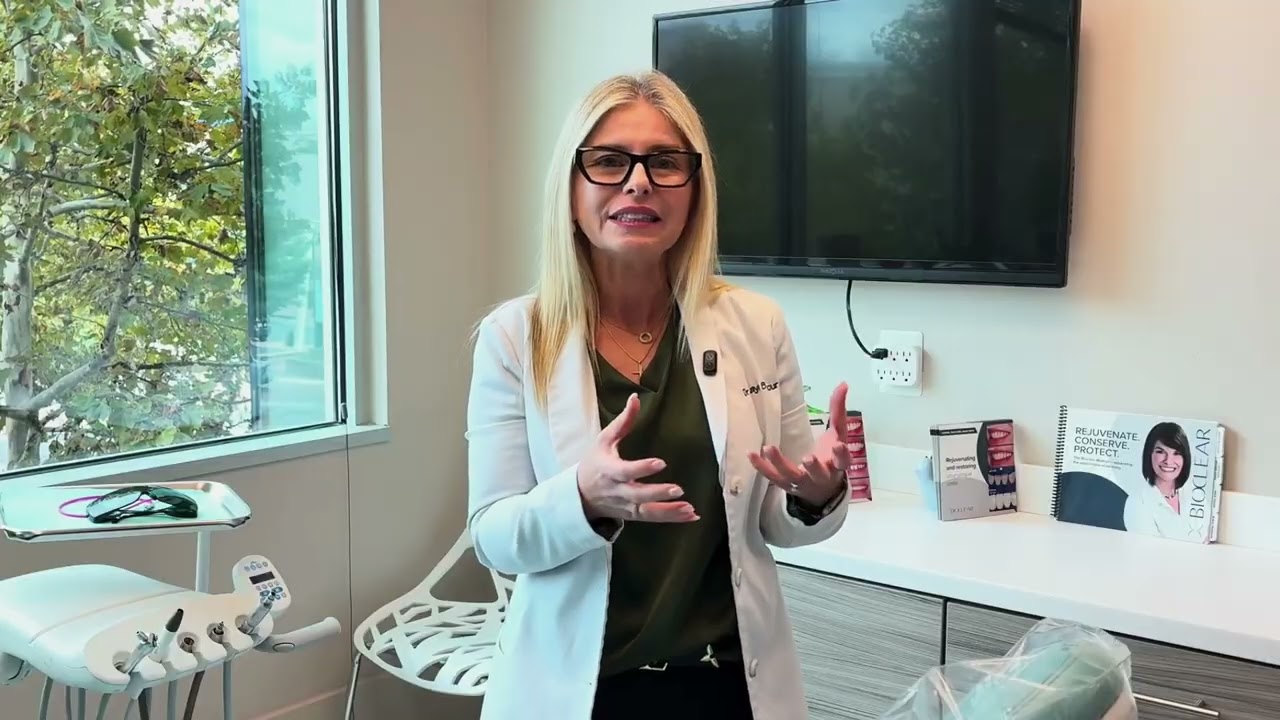
What is BioClear?
Patients walk into the office and see the signs for BioClear, and everybody has a question: What is BioClear? Besides being one of my favorite procedures to do for the past six years, BioClear is a modern, minimally invasive technique that can be used to restore teeth.
It works for both front teeth and back teeth. We can use it for chipped teeth, worn teeth, teeth with cavities, and to replace or repair existing bonding. BioClear can also help us change the shape and appearance of certain teeth.
One of the differences between BioClear and traditional freehand bonding is the technique. BioClear uses clear matrices that fit around the teeth, and then we place warmed composite material within those matrices. The material adapts around the tooth, and then we shape and polish the restoration.
What problems can BioClear address?
BioClear can address multiple problems. It can be used for front teeth and back teeth, and we can use BioClear for either cosmetic or restorative dentistry.
If you have spacing, smaller teeth, or concerns about symmetry, BioClear may be an option. We may also use it for certain chipped or worn teeth, cavities, or other restorative needs.
With that being said, every tooth is different, and it has to be evaluated individually to see if BioClear is the right procedure for that tooth.
How is BioClear different from dental bonding?
People usually mix up BioClear and dental bonding. BioClear uses composite material, but the technique is different from traditional freehand bonding.
With BioClear, we're using clear matrices that wrap around the teeth, and then we're using warmed composite material that is placed within those matrices. This technique helps us control the shape and contour of the restoration, including the emergence profile where the restoration meets the gumline.
Once the restoration is shaped and polished, our goal is to create a smooth surface and contours that are comfortable and easier for the patient to keep clean.
What are the advantages of BioClear?
The advantages of BioClear are many, but in my opinion, one of the biggest advantages is that it can be minimally invasive. I love creating smiles and restoring teeth, but I also love keeping healthy natural enamel whenever possible.
If we can preserve natural tooth structure and provide a functional, highly polished restoration, BioClear may be an option. When it's appropriately planned and performed, it can also provide a natural-looking result.
In selected cases, BioClear may allow us to restore a tooth conservatively rather than immediately moving to a more extensive restoration. However, it isn't a substitute for every crown, implant, or extraction. We need to evaluate the tooth, root, bone, and remaining structure to determine what's appropriate.
How does BioClear compare to porcelain veneers?
Both BioClear and porcelain veneers can address certain cosmetic concerns, and we have to evaluate the individual patient to decide which procedure is more suitable.
One potential advantage of BioClear is that it may require little or no removal of healthy tooth structure in selected cases. Porcelain veneers may require some tooth preparation depending on the patient's teeth and the result we're trying to achieve.
Both can be options for changing the appearance of teeth, but the right approach depends on your individual needs, the condition of your teeth, and your long-term treatment goals.
What happens during a BioClear procedure?
During a BioClear procedure, we first clean and prepare the tooth. Then we choose a matrix that fits appropriately around the tooth and place the warmed composite material.
After the material is placed and cured, a very important part of the procedure is shaping and polishing. We contour the restoration and create the surface finish so that it blends as naturally as possible with the surrounding teeth.
Is BioClear comfortable?
BioClear can be a comfortable procedure for many patients. The appointment length depends on the tooth and how much treatment we're doing.
Because BioClear can sometimes be performed with minimal tooth preparation, the experience may be relatively conservative. However, the amount of preparation and whether local anesthetic is needed depend on the tooth and the treatment being performed. We'll discuss what you can expect before we begin.
How do you care for BioClear restorations?
You can floss around BioClear restorations, and you actually should clean between them regularly. You take care of teeth restored with BioClear much like you take care of your natural teeth.
Brush twice a day and clean between your teeth with floss or another interdental cleaning method that's appropriate for you. Regular dental visits also allow us to monitor the restorations and surrounding teeth and gums.
How long does BioClear last?
It's hard to say exactly how long a BioClear restoration will last because there are many factors involved, including how you take care of your teeth and your oral habits. Clenching and grinding, bite forces, diet, dry mouth, the location and size of the restoration, and regular dental care can all affect longevity.
One benefit of composite restorations is that they may sometimes be repaired if they develop localized wear or chipping rather than requiring complete replacement. We'll monitor your restoration over time and determine what it needs.
How much does BioClear cost?
The cost of BioClear varies because closing a small space is different from restoring a tooth with significant damage. It depends on the tooth we're treating, the amount of restoration needed, and how many teeth are involved.
A consultation is a great place to start. We'll determine whether BioClear is an appropriate option and, if so, provide an estimate before treatment begins.
What kinds of treatment can be done with BioClear?
Some of the treatments that can be performed with BioClear involve spaces between teeth, including certain black triangles that may occur because of gum recession or after orthodontic treatment.
We can also use BioClear in selected cases to change the shape of smaller teeth, improve symmetry, close spaces, modify color, or address certain minor tooth-position concerns. It can also be used for restorative treatment on both front and back teeth.
In some situations, a tooth that initially appears to need a more extensive restoration may be a candidate for a BioClear restoration. However, severely damaged teeth need to be carefully evaluated to determine whether they can predictably be restored or whether another treatment would provide a better long-term outcome.
If you’re ready to schedule an exam or would like to learn more about our services, we’d love to hear from you. Call us at (703) 297-4407 or email [email protected]. We look forward to caring for your smile.